
Platyhelminthes
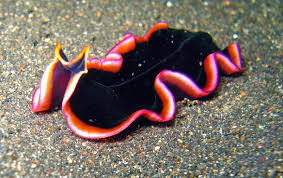
These creatures, also known as flatworms, can look just like other worms or come in a stunning array of bright colours. They can live in a wide variety of places, from the inside of a human’s liver to the ocean. Living in such environments leads to the necessity of locomotion, and of being able to tell where you are going. Let’s explore how bilateral symmetry plays a role in this:
Bilateral symmetry (symmetry where the left and right side of the animal is a mirror image) leads to cephalization, where a “head” region begins to develop:
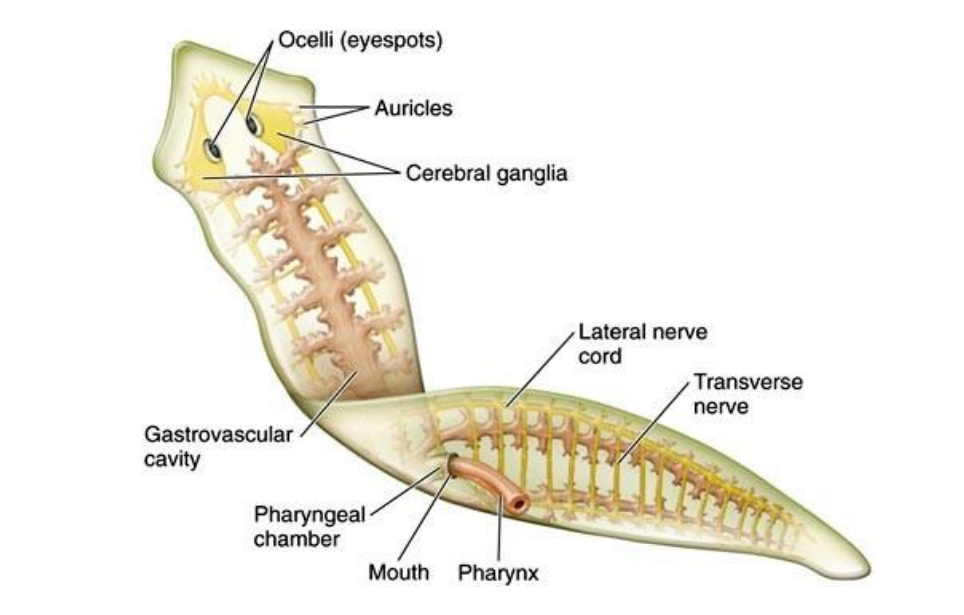
Cerebral ganglia, a primitive form of a brain, begins to develop at the anterior (front) of the animal. Sensory organs, such as eyespots, are also located in this region. This gives the worm the ability to move in a “forwards” direction, leading with the anterior and following with the posterior (back). Image credit Life Sciences 11 Notes.
Turbellaria:
- Are acoelomate
- Primarily marine, but some live on land, and the marine ones are often brightly coloured
- Often possess two eyespots towards the front of the body
- Have flat, unsegmented bodies
Trematoda:
- Mostly endoparasitic flukes (live inside organisms)- second most common parasite for a human to be infected with
- Has two suckers
- Mouth is inside the anterior sucker
- Have unsegmented bodies
- Possess a two-way digestive system
Cestoda:
- Endoparasitic flatworms that are often tapeworms
- Have a scolex (head) with hooks
- Have proglottids, or segments, that make up the reproductive structures, with the segments maturing towards the posterior end of the worm
- Do not have digestive, nervous, or excretory systems, unlike other members of Platyhelminthes