
Arthropoda

From flying creatures to deep-sea dwellers, arthropods are masters of the air, land in sea. Ranging in size from little to big, these “jointed foot” creatures use some major evolutionary developments to move around. Their exoskeleton is an important part of this:
A large exoskeleton covers the entire body of an arthropod:
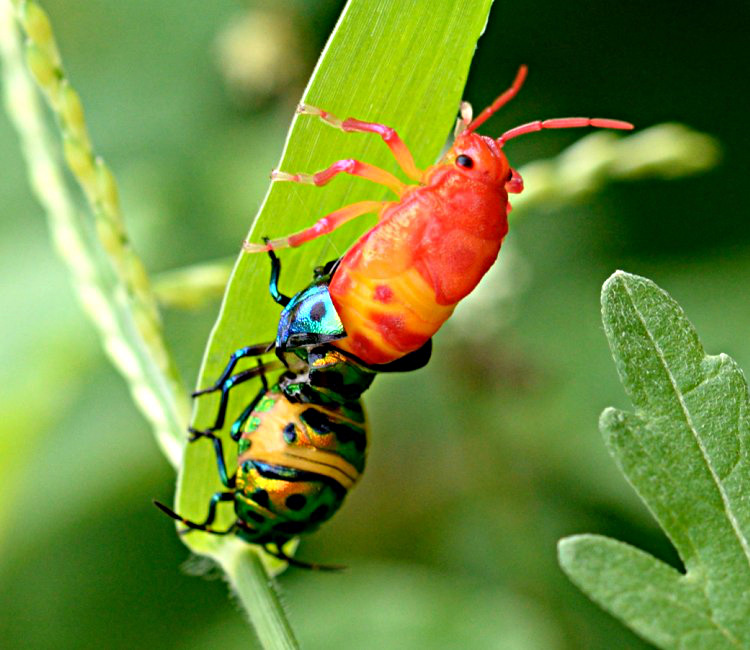
It is made of hard chitin and protects the animal from predators. As the animal grows, however, it eventually outgrows its old shell and must produce a new one. When the old exoskeleton gets too small, the animal sheds it (as seen above) and reveals a fresh, new, bigger one underneath.
Onychophora:
- Worm-like
- Primitive; least evolutionarily developed
- Lives in the jungle
- Considered a link between worms and arthropods
Chilopoda:
- Has one pair of legs per segment (2 legs per segment)
- Can be carnivorous
- Are often venomous
- Example: centipede
Diplopoda:
- Have 2 pairs of legs per segment (4 legs per segment)
- Move slowly
- Can secrete poisonous substances when threatened
- Example: millipede
Insecta:
- Have 3 pairs of legs attached to a thorax
- Often have three segments of their body: the head, thorax, and abdomen
- 2 compound eyes are usually present in the head area
- Example: grasshopper
Arachnida:
- Have 4 pairs of legs attached to their bodies
- Often have a cephalothorax- combined head and body
- Example: spider
Crustacea:
- Have 5 pairs of walking legs, and can have many more swimming legs
- The walking legs are attached to the (cephalo)thorax
- Example: lobster